This route, devised as part of the European Cool Noons project, is divided into 2 distinct sequences.
An easy one along the Corniche Kennedy to discover Malmousque and the Parc Valmer.
A sporty one to explore Endoume.
The main aim of the Cool Noons project, part of the European Interreg Euro-MED program on sustainable tourism, is to improve the visiting experience for tourists and residents of Mediterranean urban areas during the hottest hours. By the summer of 2024, it had already suggested itineraries favoring shaded or ventilated streets, as well as cool spots offering refreshment areas close to free drinking water points.
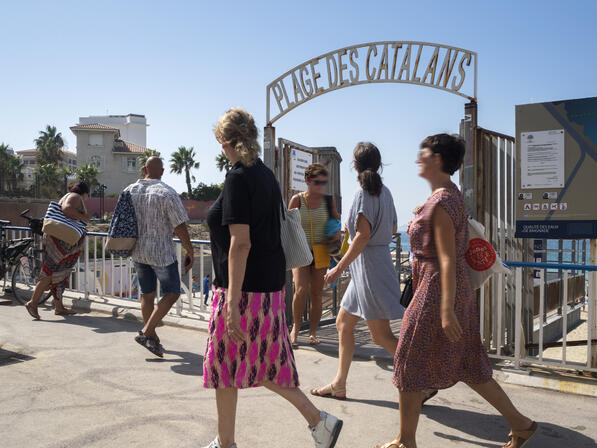
This urban hike starts at Plage des Catalans.
It is divided into two...
The main aim of the Cool Noons project, part of the European Interreg Euro-MED program on sustainable tourism, is to improve the visiting experience for tourists and residents of Mediterranean urban areas during the hottest hours. By the summer of 2024, it had already suggested itineraries favoring shaded or ventilated streets, as well as cool spots offering refreshment areas close to free drinking water points.
This urban hike starts at Plage des Catalans.
It is divided into two distinct sequences.
The first is an easy seaside section along the Corniche Kennedy, taking in the Malmousque peninsula and the Villa Valmer park.
A second, more athletic sequence explores the heights of the Endoume district.
Both can be done as a loop or separately, depending on your mood, your walking ability and the weather. The Corniche Kennedy is well served by RTM bus line 83, whose air-conditioned vehicles make it easy to reach either the Old Port or the Rond-Point du Prado, even in the hottest weather.
The starting point is the Plage des Catalans (1), dominated by the Lazaret tower.
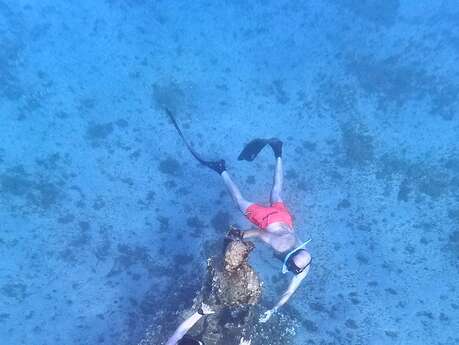
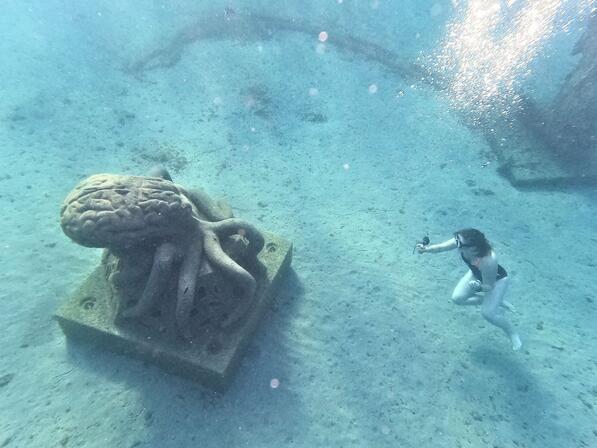
This beach is ideal for a refreshing swim. Its waters are also home to the Musée Subaquatique de Marseille (2), which can be explored with a few swims and a simple mask and snorkel.
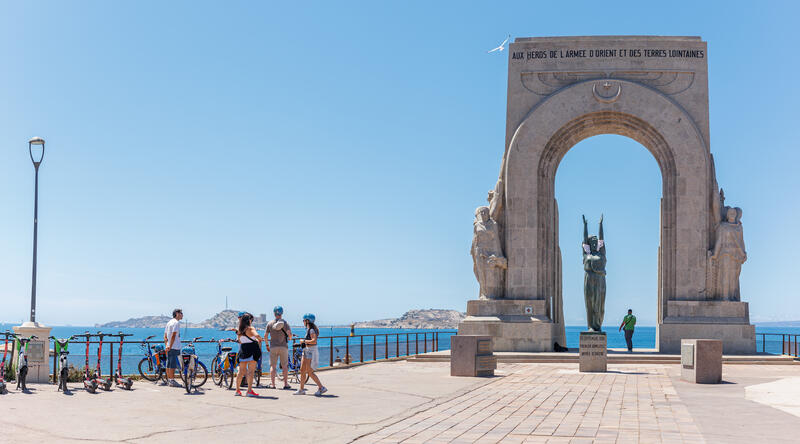
The route follows the Corniche John Fitzgerald Kennedy to reach the Malmousque district. After 700 meters, you'll reach the square du lieutenant Danjaume, home to the monument to the dead of the Armée d'Orient (3) and of distant lands.
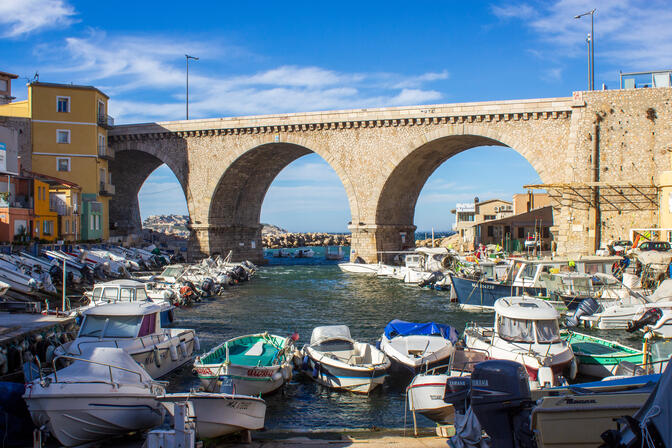
A bridge takes you over the small port of the vallon des Auffes (4).
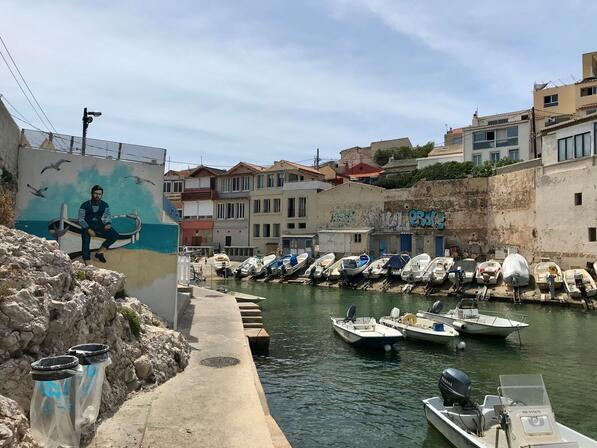
Continue on to Place Paul Ricard, a tribute to the entrepreneur and father of the famous aniseed drink (always drink in moderation). You'll also find a wall made famous at one time by the portrait of footballer Zinédine Zidane. Today, you can admire a fresco by street artist Mahn Moix, dedicated to the SOS Méditerranée association. It depicts a lifeguard scanning the sea with a pair of binoculars.
At 108 de la Corniche Kennedy, turn right to take the stairs down to rue Malmousque. Continue straight ahead until you reach the small port of Malmousque (5).
Turn left into rue Va à la Calanque and then left again into traverse Montplaisir, which leads to rue Boudouresque and a vintage façade protected by an awning. At the next crossroads, turn left to stay on rue Boudouresque and join rue de la Douane. Turn right, then left at the next intersection. You've reached the Malmousque plateau (6).
In the distance, you can see the Marseille islands. Turn right along a military field. This is the Foreign Legion convalescent and leave center. You'll come to a landscaped promontory lined with tamarisk and a pine tree. Take advantage of the low wall to sit for a moment in the shade and admire the view of the sea, the islet of Gaby, the Château d'If and the Frioul archipelago. In the distance, straight ahead, the Marseilleveyre massif, Maïre Island and Tiboulen de Maïre.
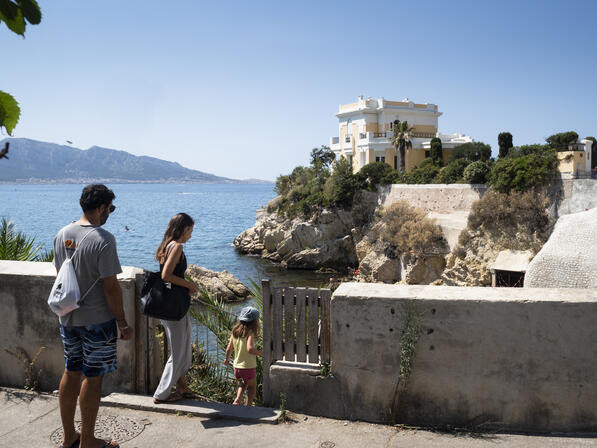
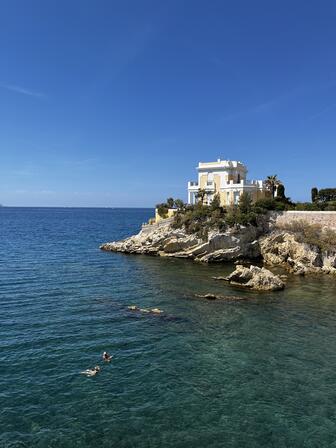
To the left of the candelabra, descend the small staircase onto a small section of the customs path. Go up rue Notre-Dame des Grâces and turn right onto rue de la Douane. You'll pass the Endoume marine station and its oceanology center (7). A new staircase takes you to the cove of the batterie des Lions. On a peninsula overlooking the sea, admire the Petite Ourse villa (8).
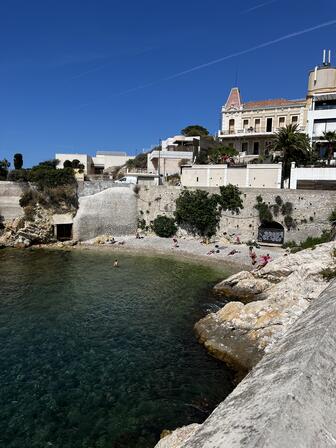
Continue along the seafront path to reach Anse de Maldormé (9).
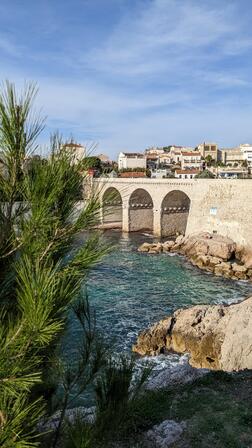
You'll pass some of Marseille's finest mansions. Continue until you reach the parking lot entrance to Le Petit Nice, the five-star establishment of 3-Michelin-star chef Gérald Passédat. On the right, a staircase leads back to the seafront, bypassing the luxury establishment. The large, flat rocks are popular with bathers, especially on mistral-force days. Pass under the Fausse Monnaie bridge and discover the port of the same name. (10) Follow the stairs on your left, which will take you up to the Corniche Kennedy.
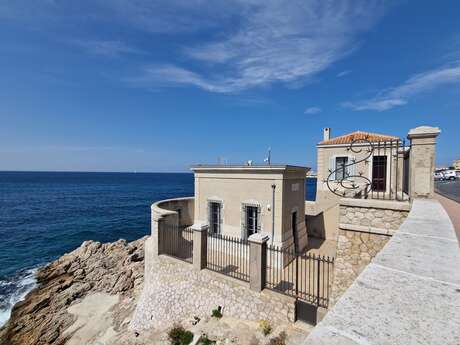
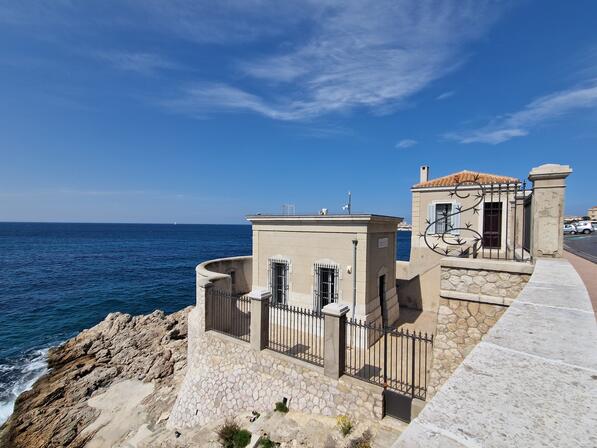
Continue along the Corniche. You'll pass the famous Marégraphe (11). Shortly afterwards, a crosswalk allows you to cross the road before reaching the entrance to the Villa Valmer park (12).
This concludes the first part of our tour of the Endoume and Malmousque coastal districts.
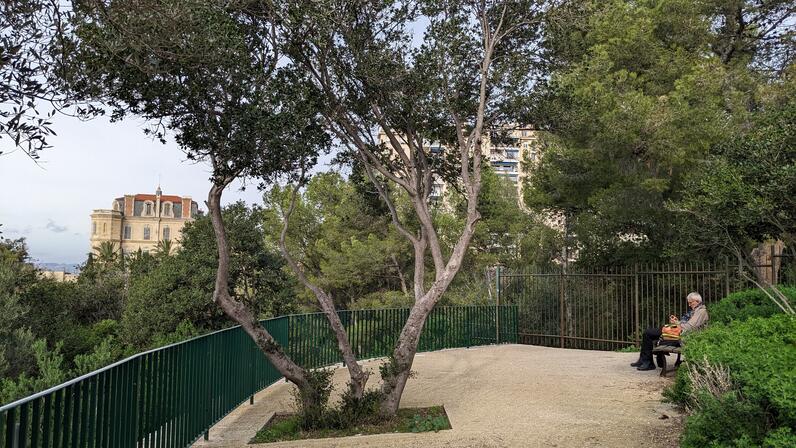
The Villa Valmer park is a lovely wooded area, ideal for a moment's rest. It features picnic tables, fountains and amenities.
Walk up the central driveway and turn right. Walk between pines and oaks to reach the exit onto rue du Docteur Frédéric Granier. Continue until you reach impasse Arnaud Bompard on your right. A few meters further on, you'll see a commemorative plaque dedicated to "radiophonic" resistance fighters. Retrace your steps to continue around the park of the large Montvert residence. At the end, turn left along Rue des Flots Bleus. Despite the high fences, you can still see the sea in the distance. Turn right onto chemin du pont, which refers to the Fausse Monnaie bridge on the Corniche. At the next intersection, do the same and branch off into the Targuist traverse.
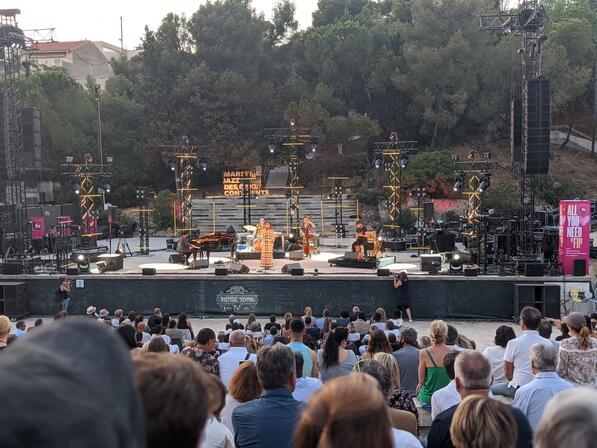
The Pont de la Fausse Monnaie and the steps can be seen. This is a beautiful green space, the Théâtre Silvain (13).
In fine weather, this municipal facility offers a varied and popular program of shows. Pass the boulodrome Targuist, which is once again an open space for pétanque players. Shortly afterwards, turn right into rue Papon, which continues into impasse Fouque. The cypress avenue will be your ally.
As you go up the alley, admire the view of the Basilica of Notre-Dame de la Garde, which can be seen in the distance between the houses. The houses often look alike and are characteristic of the "3 fenêtres marseillais" style. This is a typical downtown construction, particularly common from the 17th century to the early 20th century. The apartments, spread over several floors, have three windows opening onto both the street and the interior courtyard, and floors supported by wooden beams set into the party walls perpendicular to the street, as the facades are not load-bearing.
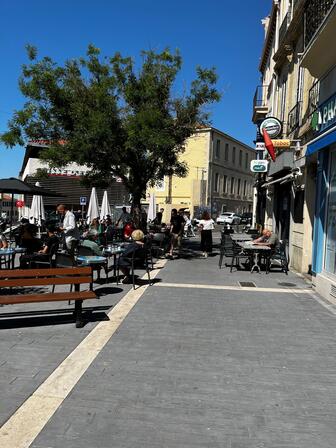
Take rue du Docteur Granier to reach rue d'Endoume and turn right. You'll soon arrive at Place Saint-Eugène, the heart of Endoume village(14).
From rue du vallon des Auffes, turn into rue Robert et Fénelon Guidicelli. Robert was a young resistance fighter murdered by the Gestapo in Lyon on August 9, 1944. He was 33 years old. A plaque honors his memory. Next up is the "A la bonne Fama" house of the headless woman. It was common practice in the past to represent "fame" in this way. Fama" means "good reputation" in Latin, as an explanatory sign indicates. Continue on to the Samatan plateau, a former fishing district. From Rue Sollier, you can admire the Corniche and seafront below.
Rue du Four à Chaux and Rue Paul Codaccioni take you off the plateau. At number 71 rue Charras, turn right down the stairs that provide a pedestrian-only shortcut to rue de Nice. This leads to the shady Place du 4 septembre. September 4, 1870, marks the deposition of Emperor Napoleon III and the proclamation of the Third Republic.
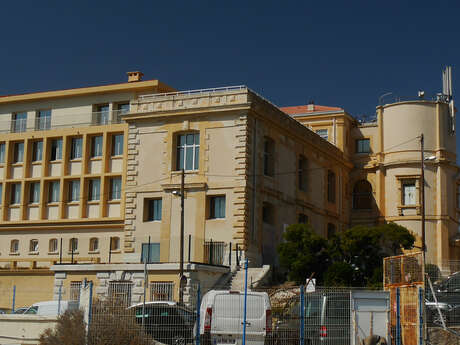
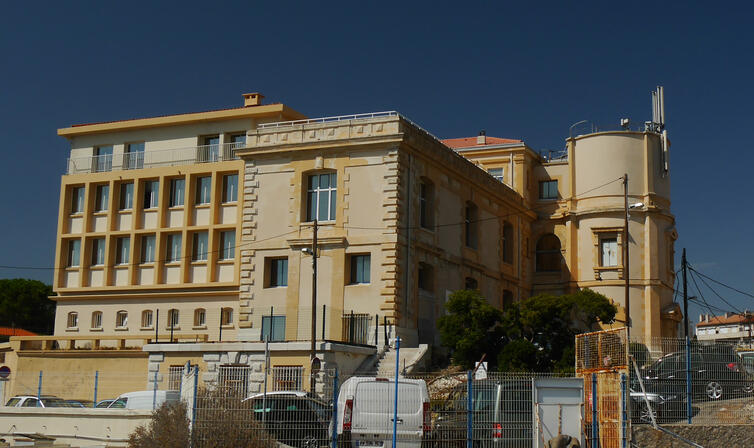
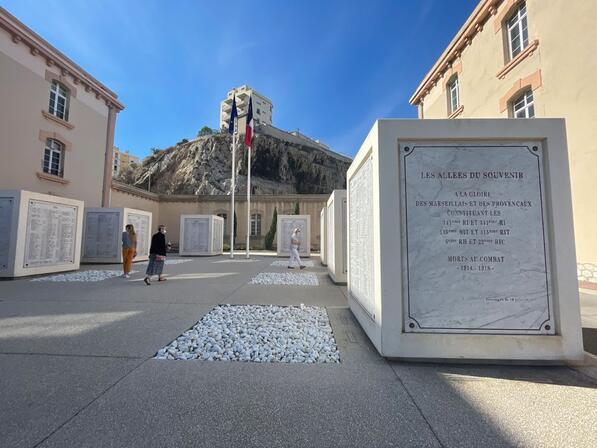
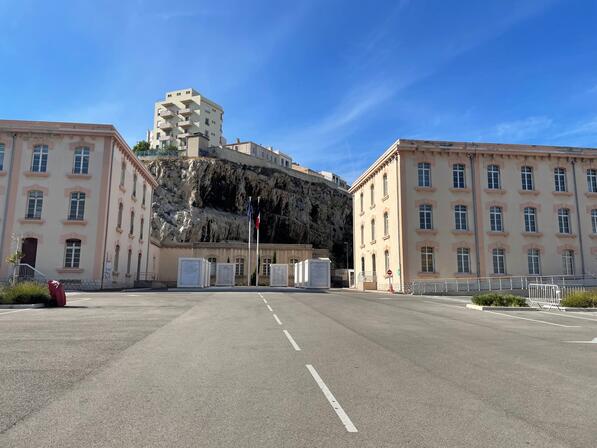
The walk ends on Avenue de la Corse, which takes you back to the starting point at Plage des Catalans. But before you finish, you'll pass a large building, the Saint-Georges, a housing unit (15) and the Audéoud barracks (16).
n the Middle Ages, this site was mainly farmland and vineyards, taking advantage of its privileged location on the Mediterranean coast. Over time, the plateau's landscape was transformed by the gradual urbanisation of the area. In the 19th century, it became a popular spot for its exceptional views over the sea and the bay of Marseille. Today, the Plateau de Malmousque is an emblematic site that retains a picturesque atmosphere, with narrow streets, small fishermen's cottages and opulent villas sheltered behind high walls with uninterrupted views of the sea.
This villa is a dream come true. Perched on a private peninsula, between two turquoise coves, its location offers a 360° view of the deep blue sea. It was built in the 19th century, like so many other beautiful residences in the area and on the Corniche, known here as “follies”. It was originally known as Café Buffet, a restaurant open to the public. It then took the name of Villa Joconde before keeping the name of Petite Ourse. It was once home to a Japanese consul, hence the kanji character on its doorway, which is thought to be a woman's first name. It was at the end of the 20th century that its name came to refer to that of the Guérini clan, Marseilles' notables and politicians linked to disreputable individuals. Today it belongs to private individuals who know that to live happily, it is better to live hidden. The house lends itself perfectly to this french adage.
9Maldormé cove
It's a tiny pebble beach nestling at the foot of the prestigious Petit Nice Passédat hotel. It is very well protected from the wind, but like all the small coves in the area, it is a victim of its own success on sunny days.
The name is linked to the old watchfires that were established along the coast from the 13th century, near the port of Doume. Hence the derivation En-Doume, as people used to say ‘go to Doume’, just as they used to say ‘go to the country’. Initially, fishermen and craftsmen lived here. In the 19th century, with the construction of the Corniche, the district attracted wealthier Marseillais. The result was a clever mix of small houses, cottages and very fine residences.
15Saint-Georges building
This 21-storey building is part of Le Corbusier's vision of housing units.
When it was inaugurated in 1963, it was one of the tallest buildings in Marseille. It brings together flats, shops, a school, cultural facilities and a church. In 2006, it was awarded the Heritage of the 20th Century label.