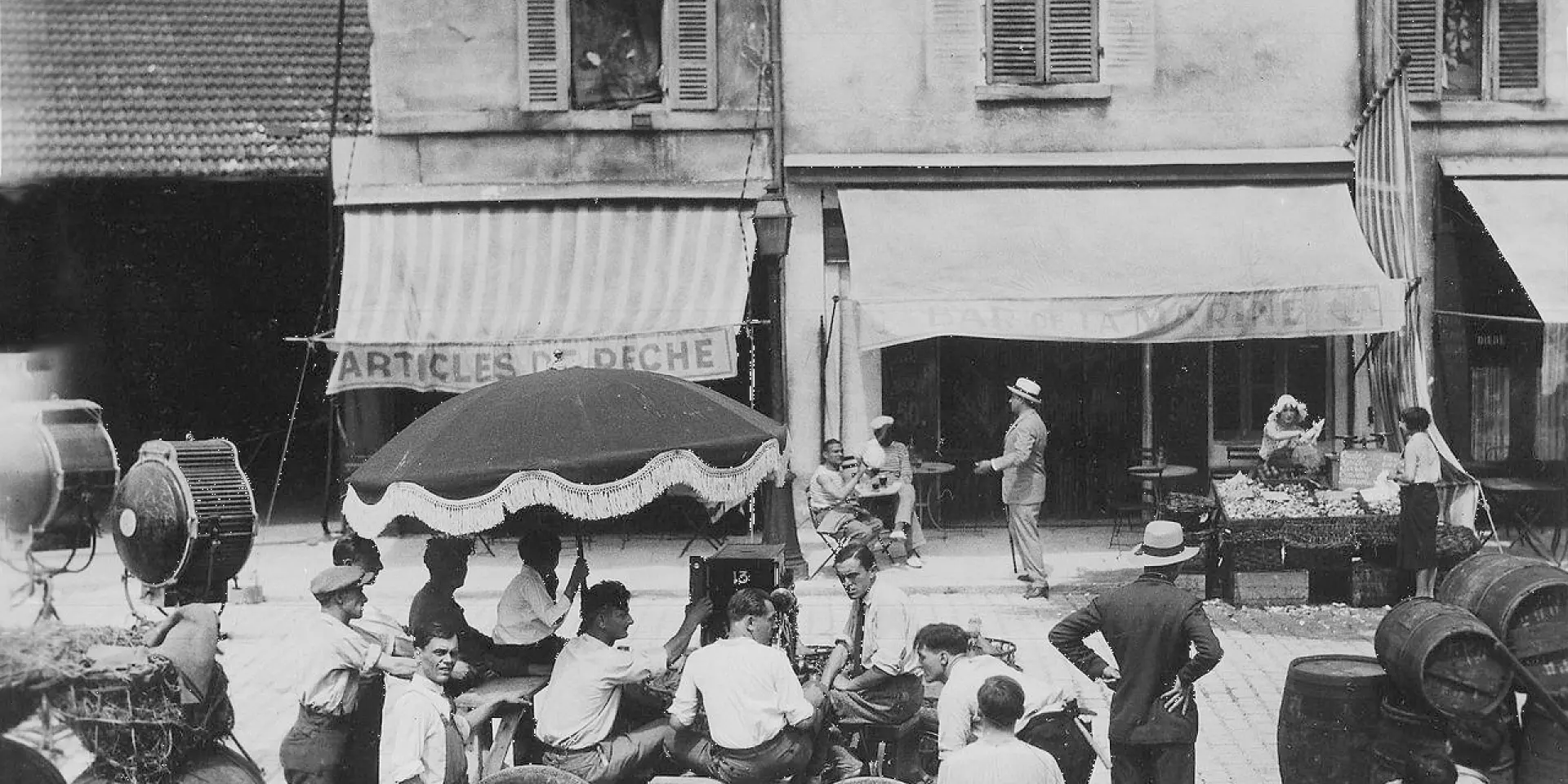
Tournagemarius 1931 Paramountwikimediacommonscollectif. Paramount FranceTournagemarius 1931 Paramountwikimediacommonscollectif. Paramount France
©Tournagemarius 1931 Paramountwikimediacommonscollectif. Paramount France
Marius, Fanny, César

The Marseilles Trilogy

Marcel Pagnol has made a major contribution to raising the profile of Marseille and Provence beyond our borders. Among his best-known works, the Trilogie Marseillaise, made up of three plays adapted into films, is part of our identity: (re)discover the legacy of Marius, Fanny and César in Marseille!

A timeless story of love and family

Through the intertwined destinies of Marius, Fanny and César, Pagnol paints with tenderness and acuity a family, social and love fresco of rare accuracy.

Marius, a young man who dreams of adventure and faraway lands, works in his father César’s bar, whose truculent personality makes him a key figure in the neighbourhood. Marius’s heart is torn between the call of the sea and his growing feelings for Fanny, a seashell seller. But he has to make up his mind, and in the end he chooses the sea.

Fanny, abandoned by the man she loves, must face the weight of dishonour. Marius has left her a gift that is both magnificent and terrible for its time, and the young woman must resolve to marry another man (Panisse) to escape dishonour and preserve the little life that is so precious to her.

César is reunited with Marius years later. Time has passed and some wounds seem to have healed, but the truths have never ceased to weigh. The old man, behind his lofty words and superficial humour, hides a deep and tender love for his son, whom he has never really forgiven for leaving him. Césariot (Marius and Fanny’s son), a successful young adult, discovers the secrets of his conception.

The themes addressed by Marcel Pagnol in La Trilogie Marseillaise are timeless, and continue to resonate with audiences almost a century later.

Colourful language and straightforward speech

What makes this trilogy so lively, over and above the story, is undoubtedly the language. Pagnol infuses it with popular, lilting and colourful language. This accent and choice of words are never caricatured, and the witty, ironic and tender lines demonstrate the talent of the man who would one day become a member of the Académie française. Everything is often said in a single line.

A whole world comes to life through César, Panisse, Honorine and Escartefigue. The card game scene, featured in Marius, encapsulates all of Marcel Pagnol’s magic and poetry.

From theatre to film, a huge success

The Marseillaise Trilogy consists of three plays adapted for the cinema.

Marius was performed for the first time in Paris on 9 March 1929, and was an instant hit. The film adaptation was made in 1931, and the 120-minute film was as successful as the play.

Fanny arrived on stage at the end of 1931. The film came out in 1932 and lasted 140 minutes.

Unlike the first two parts,César was written directly for the cinema. It was shown for the first time in cinemas in 1936. It was adapted for the stage ten years later, and premiered in Paris in 1946.

Some of the greatest actors and comedians of the period appeared on stage or screen, including Raimu as César and Pierre Fresnay as Marius.

Numerous adaptations in France and abroad have paid tribute to or revisited the Marseillaise Trilogy: plays, TV films, record versions and even an opera have renewed our view of these three landmark works by Marcel Pagnol.

In the footsteps of Marius, Fanny and César in Marseille

Marseille offers a lively journey through the emblematic places of Pagnol’s world.

The Bar de la Marine, on the Old Port, evokes this legendary bar. Although the place was born of Pagnol’s imagination, the current bar is located on the set of certain scenes from the films and recreates the soul of the Marseilles Trilogy. Here, you can enjoy a drink while imagining the voices and laughter that once resounded here, between two lively card games.

A few steps away, you can board the ferry-boat, the famous boat humorously mocked by César and Panisse. Modernised and now powered by electricity, it continues to transport visitors and locals from one bank to the other, as a nod to the past.

Away from the city centre, the Château de la Buzine, which Marcel Pagnol bought without knowing that it had played an important role in his childhood memories, has been renovated and transformed into a cultural venue. It now houses the Espace Pagnol, dedicated to Pagnol’s childhood memories and his film and literary work.

To relive the Marseillaise Trilogy in Marseille is to plunge into a collective memory made up of emotions, unforgettable dialogues and landscapes bathed in light.